
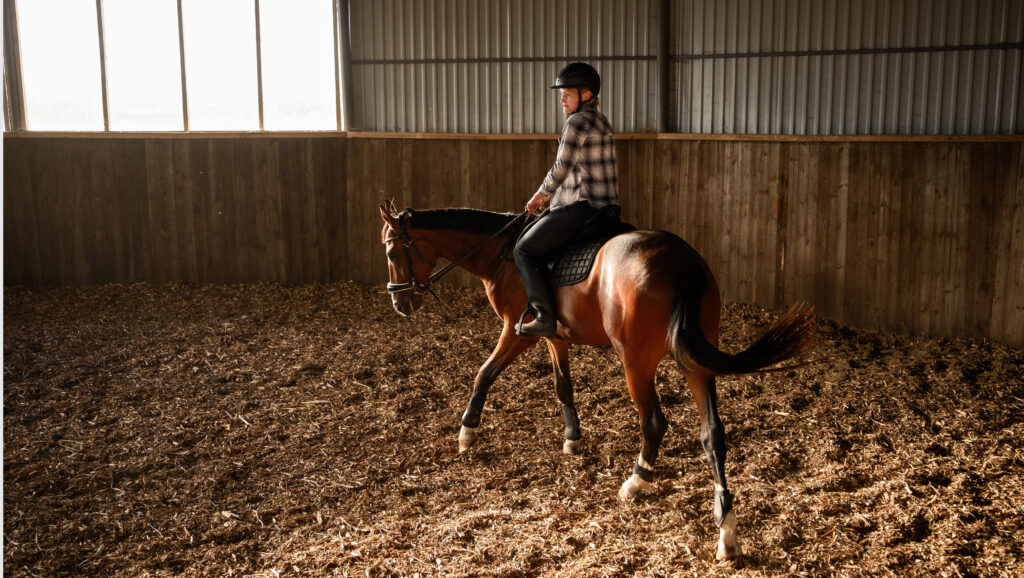
For horse owners, trainers and yard managers, few decisions have a greater impact on horse welfare and performance than the surface they train on. That’s why more professionals are turning to natural, screened and dust-extracted woodfibre surfaces.
When a horse is moving at speed or landing after a jump, enormous forces travel up through the hoof, fetlock, tendons and joints with every stride. The structure of the hoof and limb is designed to absorb these impacts, but the surface beneath the horse plays a crucial role in how those forces are distributed.
If the footing is too hard, too loose or inconsistent, the surface itself becomes an injury risk. So understandably, arena and gallop surfaces are an important consideration in
the equestrian sector.
The importance of surface quality
Good surfaces reduce the amount of limb loading by providing shock absorption, also known as damping. This cushioning reduces the peak forces transmitted through joints, tendons and ligaments during movement.
But a training surface must strike a careful balance between support and cushioning. If the surface is too firm, the forces transmitted through the horse’s limbs increase. This can contribute to long-term wear and tear or injuries. Conversely, if the surface is too soft or unstable, horses may expend more energy moving through it, increasing fatigue and the risk of tendon strain.
The ideal surface therefore needs to provide:
- Consistent grip
- Controlled cushioning
- Energy return
- Predictable stability
These characteristics help horses move efficiently while reducing musculoskeletal stress.
Concussion and the risk of long-term injury
In horses, repeated high-impact forces can contribute to a range of concussion-related orthopaedic issues including tendon injuries, joint strain and degenerative conditions. Veterinary research has shown that poor surfaces can increase stress on structures such as the suspensory ligament and flexor tendons, while excessive concussion may also contribute to foot conditions and joint wear.
In extreme cases, repeated impact stress has been linked to conditions affecting the foot and navicular structures, where excessive concussion can overload the structures designed to absorb shock.
For trainers and yard managers responsible for valuable horses, the long-term consequences of poor surfaces can therefore be significant.
The respiratory issue many arenas overlook
Arena surfaces can also affect equine respiratory health. Naturally, when horses exercise, they breathe more deeply and at much higher rates than when resting. In dusty environments, this means greater quantities of airborne particles are inhaled directly into the lungs.
Dust generated by riding surfaces may contain organic particles, soil material, bacteria, mould spores and other irritants. Studies have shown that airborne dust exposure can irritate the respiratory system and contribute to airway inflammation in horses.
Respirable dust has also been linked to inflammatory airway disease and conditions such as recurrent airway obstruction, a respiratory condition similar to asthma.
In practical terms, excessive arena dust can:
- irritate the horse’s airways
- reduce respiratory efficiency during training
- impact performance
- affect the health of riders and yard staff
This is why dust control has become a major consideration when selecting arena materials.
Why NATURAL woodfibre surfaces are widely used
Woodfibre surfaces have long been used in racehorse gallops and training arenas because they offer a combination of shock absorption, stability and natural drainage. They are also free from airborne contaminants.
The fibrous structure of the material helps create a surface that:
- cushions the hoof impact
- distributes force through the surface
- provides consistent grip under the hoof
When properly processed, woodfibre also produces far less airborne dust than many traditional surfaces.
This combination of shock absorbency, stability and low dust generation is why many trainers consider woodfibre an effective training surface for gallops and arenas.
Why dust extraction makes a difference
Not all woodfibre surfaces perform the same. One of the key factors affecting performance is the amount of fine particulate matter present in the material. During production, screening and dust extraction removes these fine particles, leaving a cleaner and more consistent fibre. This helps reduce airborne dust during training sessions, creating a healthier environment for horses and riders alike.
Given how sensitive horses’ respiratory systems can be to dust exposure, this processing step can make a significant difference to the usability of a surface, ensuring material is clean, natural and free from unnecessary contaminants.
A natural material, responsibly sourced
Ransfords produce Equestrian Woodfibre in its purest form – milled and screened direct from British forests. The result is a 100% natural surface, with NO forever chemicals, NO plastics, NO metal and NO synthetic additives.
By processing materials direct from the forest we can transform a natural product into a high-performance training surface.
The benefits extend beyond the arena itself.
Ransfords Equestrian Woodfibre is produced from sustainably managed British forests, helping support the rural economy and ensuring that British forests are actively managed for future generations. Local sourcing reduces transport distances, lowering the carbon footprint.
Ransfords Equestrian Woodfibre delivers a natural surface that supports horse and rider welfare, performs consistently and is produced responsibly within an all-British timber supply chain.
A surface you can evaluate with confidence
Choosing the right arena or gallop surface is an important decision. Owners, trainers and yard managers need to be confident that the material beneath their horses will perform reliably day after day.
That means considering more than just cost. Shock absorption, dust levels, fibre consistency and long-term durability all play a role in creating a safe and effective training environment.
Ransfords has been supplying the equestrian industry with high-quality, durable and eco-friendly Equestrian Woodfibre surfaces for over 30 years. Our milled and screened surfaces offer:
- better shock absorbency to reduce concussion through the limbs
- more consistent footing that supports safe, controlled movement
- reduced dust levels for healthier respiratory conditions
- a natural surface produced from sustainable British forests
And because our product is completely natural and non-synthetic, there are no landfill headaches when the surface finally needs replacing.
Don’t just take our word for it
Of course, the best way to assess a surface is to see it for yourself.
That’s why Ransfords offers free, no-obligation samples of its screened Equestrian Woodfibre material. You can examine the fibre quality, consistency and feel of the product before deciding whether it’s right for your arena or gallops.
To request a sample or discuss your requirements, contact the Ransfords team on 01588 638331 or get in touch here.