
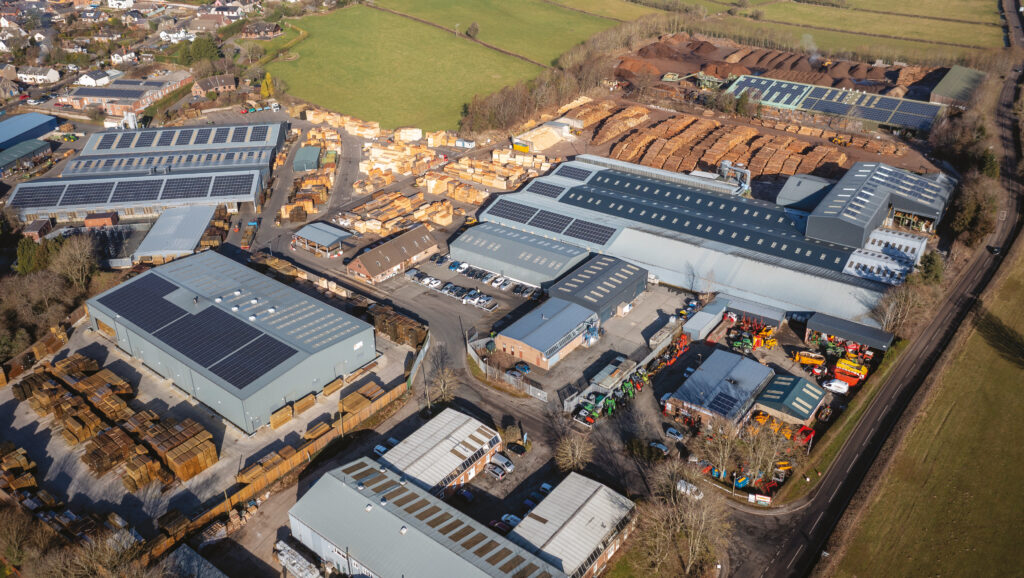
When we talk about sustainability, we’re usually referring to practices that don’t harm the environment. But at Ransfords, it’s much more than that.
From our site in Bishop’s Castle in rural Shropshire, we have always relied on our environment. The health and biodiversity of the forests that supply our timber. The families and businesses that make up our community. The success of our customers and the skills and commitment of our workers. For 150 years, our livelihood has depended on the health of that ecosystem and the strength of those interdependent relationships.
Sustainability goes deeper than simply adhering to environmental standards. Of course, looking after woodland, minimising waste and investing in the local area makes us a good neighbour.
But it’s much more than that.
It’s about supporting rural jobs. Strengthening the British timber supply chain. And protecting continuity of supply – giving our customers confidence that the material they rely on will be available for the long term.
In short, sustainable operations make sound business sense. And every part of how we operate today reflects that belief.
British-grown timber isn’t just about patriotism
Ransfords uses British-grown timber from sustainably managed UK forests. And that matters for several reasons.
• Fewer lorry miles, lower carbon emissions
Shorter transport distances reduce fuel use and associated emissions, helping lower the overall carbon footprint of every load we deliver
• Greater traceability and accountability
Local sourcing provides clearer visibility of origin, giving customers confidence in where their timber comes from and how it has been managed
• Healthier, responsibly managed forests
Supporting UK forestry helps ensure woodlands are actively replanted and managed for future generations, protecting long-term timber availability
• A stronger rural economy
Investing in our domestic supply chain supports rural forestry jobs and local businesses in Shropshire and across the UK
• Improved market resilience
By favouring species suited to UK conditions and strengthening British supply chains, we help reduce dependency on volatile international markets and improve continuity of supply.
This is not just environmental thinking. It’s supply-chain thinking. A strong local supply base reduces market volatility while supporting national woodland stewardship.
Zero waste is not just a slogan
Timber processing inevitably produces offcuts, sawdust and by-products. But at Ransfords, we operate a zero-waste approach to manufacturing, ensuring every part of the log is used productively.
Sawdust and wood fibre are repurposed, lower-grade material is redirected into appropriate applications and nothing that can be used is sent to landfill. For Ransfords, that equates to 35,000 m3 of production residue – repurposed.
This principle of full resource utilisation is both environmentally responsible and commercially sound. Waste represents lost value. Using every part of the tree reflects a culture of efficiency and respect for the raw material.
And it also allows us to produce additional products, including high-quality, dustextracted woodfibre for equestrian surfaces, turning what might otherwise be byproduct into a valuable, specialist material.
Renewable energy and operational efficiency
Being a responsible business also means examining how operations are powered, on a continuous improvement basis.
Ransfords has invested in solar generation, reducing reliance on grid electricity and contributing to a lower operational carbon footprint. Over 4,000 solar panels on our site generate more than 1.2 MW of clean power each year, helping to power our milling operations with the energy that grew our timber in the first place.
Alongside this, ongoing investment in sawmilling, kiln drying and treatment processes supports efficiency and consistency. Efficient machinery reduces waste, optimises yield and helps ensure that treatment processes are carefully controlled.
Environmental responsibility is often discussed in lofty, headline terms. In practice, it is built through hundreds of relatively small operational decisions that reduce inefficiency and improve control.
Carbon storage for decades
Ransfords also owns 2,000 acres of woodland, storing an estimated 386,000 tonnes of CO2. That woodland is not just an asset on paper. It represents active stewardship and long-term environmental responsibility.
Timber is a renewable material that continues to lock away carbon even after it has been processed and installed. When used in fencing, cladding, landscaping or infrastructure, wood can store carbon for decades.
This dual benefit, carbon storage in woodland and carbon locking in end-use products, is one of timber’s most compelling environmental credentials. And it’s also one reason why responsibly sourced timber plays an increasingly important role in sustainable construction.
Responsibility that goes beyond the environment
Environmental responsibility is only one part of our commitment to sustainable practice.
As one of the larger employers in the Bishop’s Castle area, we support local jobs, working wherever possible with local suppliers and contributing to a sustainable rural economy. We engage with local schools and community initiatives, recognising that long-term success depends on strong local relationships.
And we’re also aligned with recognised industry bodies and quality schemes, reinforcing our commitment to responsible sourcing, compliance and operational accountability.
A responsible business is not defined by one initiative. It is defined by consistent behaviour over time.
Sustainability that supports performance
But none of this should ever come at the expense of product quality or service reliability.
Sustainably-sourced timber must still meet exacting performance standards. Zero waste production must still sit alongside consistently high levels of customer satisfaction. Investment in solar energy can never replace dependable supply.
At Ransfords, sustainable practices are fully integrated with our operational resilience. British-grown timber reduces transport miles and strengthens supply continuity. Zero waste improves efficiency and resource utilisation. Responsible woodland management ensures long-term availability of raw material.
We must be doing something right
We’ve been in business for 150 years. Longevity on that scale is not achieved through short-term thinking.
It requires respect for the land that provides the resources we utilise, care for the communities that support our workforce and a commitment to processes that minimise waste and maximise value.
It’s the only way to build a business that lasts.